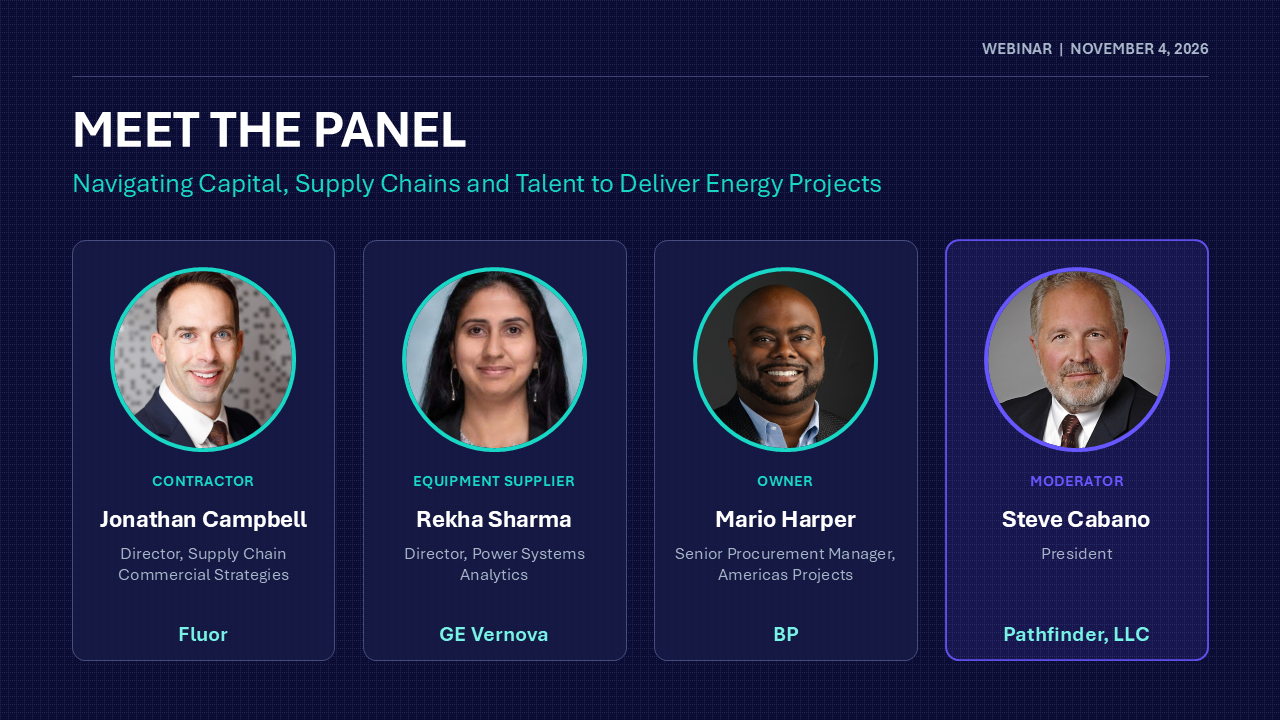
Today's webinar, Navigating Capital, Supply Chains and Talent to Deliver Energy Projects, brought together perspectives from owners, contractors, and equipment suppliers to explore one of the industry's most pressing challenges: how to successfully deliver major capital projects amid growing competition for resources, accelerating schedules, and evolving market demands.
Delivering Projects at the Speed of Demand
The discussion opened with an examination of how project timelines are shrinking across multiple sectors, including energy, data centers, oil and gas, pharmaceuticals, and mining. Panelists noted that organizations are increasingly being asked to make investment decisions faster and execute projects more rapidly, even as they compete for many of the same skilled workers, engineering resources, equipment, and critical materials.
As project owners race to capitalize on market opportunities, traditional project delivery approaches are being reevaluated. The panel explored how changing business cases and heightened expectations for speed are forcing organizations to rethink procurement strategies, engineering workflows, and workforce planning from the earliest stages of project development.
Supply Chain Competition Remains a Critical Challenge
A key theme throughout the webinar was the growing competition for supply chain resources across sectors. Major industrial projects that once operated within largely independent ecosystems now find themselves vying for the same manufacturers, fabrication capacity, electrical equipment, and construction talent.
Panelists emphasized that successful project delivery increasingly depends on understanding equipment lead times early and incorporating supply chain realities into project planning and design decisions. Rather than assuming critical equipment will be available when needed, organizations are finding greater success by proactively aligning project schedules with supplier capabilities.
Strategies for Accelerating Project Delivery
Several practical approaches emerged during the discussion as organizations seek to reduce risk and improve project outcomes:
Early Procurement and Engineering Alignment
Speakers highlighted the importance of engaging procurement and engineering teams much earlier in the project lifecycle. Early collaboration enables organizations to identify long-lead items, evaluate alternative specifications, and make informed decisions before schedules become constrained.
Standardization and Modularization
The panel discussed how standardization and modularization continue to gain traction as effective methods for accelerating project execution. By leveraging repeatable designs and modular construction strategies, organizations can reduce engineering effort, improve predictability, and shorten construction schedules while helping mitigate labor constraints.
Designing Around Equipment Availability
An increasingly important strategy involves designing projects with equipment availability in mind. Rather than developing designs first and sourcing equipment later, project teams are evaluating supply chain conditions earlier and considering available products and manufacturing capacity as key project inputs.
Workforce Resilience Takes Center Stage
In addition to supply chain concerns, workforce availability remains a significant challenge across project-intensive industries. Panelists discussed the need for organizations to develop more resilient talent strategies, including workforce planning, skills development, and improved collaboration between owners, contractors, and suppliers.
As demand for new infrastructure and industrial capacity continues to grow, the ability to attract, retain, and effectively deploy skilled talent will remain a critical differentiator for successful project delivery.
Looking Ahead
The webinar reinforced a common message from industry leaders: project success today requires more than funding and technical expertise. Organizations must take an integrated approach that aligns capital planning, engineering, procurement, supply chain strategy, and workforce development from the outset.
As competition for resources intensifies across energy, data centers, pharmaceuticals, mining, and other capital-intensive sectors, companies that proactively address supply chain and talent challenges will be best positioned to deliver critical projects safely, efficiently, and on schedule.