
Project teams are accustomed to managing scope changes. New requirements, unforeseen conditions, and owner-directed modifications are all common realities of complex capital projects. Yet some of the most challenging disputes arise not from new work, but from work that was arguably required all along.
This phenomenon, often referred to as scope migration, occurs when activities an owner believes were included within a contractor's original scope later reappear as requests for additional compensation. This describes a commercial issue, not a contractual basis for payment. Each request must be evaluated against the executed agreement and the circumstances that prompted it.
The consequences can be significant. Project teams become distracted by contract interpretation, decision-making slows, relationships become strained, and budgets come under pressure. Owners may also risk duplicate payment if an additional charge covers an obligation already included in the agreed price.
How Scope Migration Happens
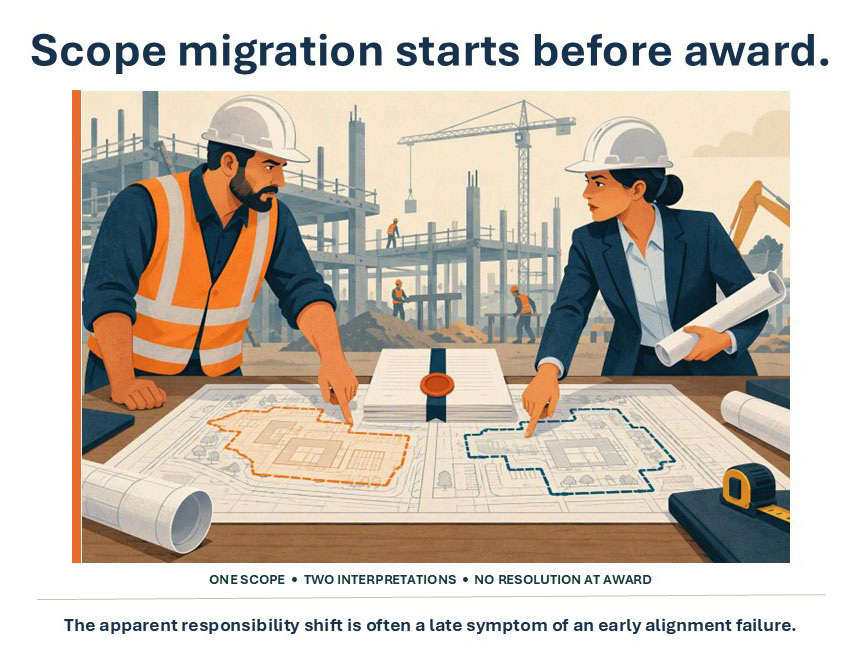
Scope migration rarely occurs because one party intentionally attempts to shift responsibility. More often, it stems from differing interpretations established long before construction or execution begins and left unresolved at award
.
During procurement, owners generally develop Requests for Proposals (RFPs) that outline project objectives, requirements, interfaces, and expected deliverables. These documents should define the scope boundaries and allocation of responsibilities, even when every supporting activity cannot be listed.
Owners rely on the expertise of contractors to identify the full range of activities needed to achieve the agreed scope. Contractors prepare proposals based on their understanding of the work, supported by assumptions, exclusions, qualifications, and estimating methodologies. Expertise alone does not create an unlimited obligation to deliver everything the project requires.
The challenge arises when those assumptions and qualifications are not reconciled, or their acceptance and incorporation into the contract remain unclear.
At award, both parties may believe they have established a clear understanding of the work. Months later, when a specific activity becomes necessary, they discover they were operating under different interpretations all along.
The Central Question: Is It Really a Change?
When additional services are requested, project teams often focus on a simple question:
"Is this a change?"
Unfortunately, the answer is rarely straightforward.
To evaluate the request effectively, owners should consider several related questions:
- What does the executed contract require, including incorporated scope documents?
- Which proposal assumptions and exclusions were accepted and incorporated?
- How does the agreed order of precedence resolve conflicting documents?
- What changed from the baseline, and which provision supports an adjustment?
- What evidence supports the claimed cost and schedule impact?
Work necessary for the project is not automatically one contractor's obligation. Conversely, work required by the contract does not become additional scope merely because it was omitted from an estimate. Distinguish a genuine scope change from an estimating omission, cost overrun, or gap between participants' responsibilities.
Without this analysis, decisions can become driven by perception rather than evidence.
Contract Type Does Not Eliminate the Risk
Neither lump-sum nor reimbursable contracts eliminate scope disputes. Their payment provisions determine how the financial consequences are allocated.
Under firm lump-sum arrangements, an estimating omission is generally the contractor's risk, subject to the contract's terms. A price or time adjustment requires a supporting contractual basis, rather than evidence that the contractor underestimated the work.
Under reimbursable agreements, eligible costs of performing the original scope may remain payable even if underestimated. Review agreed rates, cost eligibility, authorization requirements, fee provisions, and any contractual ceiling. Additional cost is not automatically additional scope or grounds for an increased fee.
In both cases, the root issue is typically the same: misalignment between expectations and documentation.
An estimate or budget is not automatically a binding cap. A contractual not-to-exceed amount, however, does not automatically increase because more hours are needed. Follow the applicable notification and approval provisions.
Require a current estimate to complete and reconcile actual costs with authorized work. Keep scope changes, forecast increases, and fee adjustments distinct.
Contract type may influence financial consequences, but it does not eliminate the need for clearly defined responsibilities and deliverables.
Establishing an Evidence-Based Approach
When scope migration issues emerge, owners should resist the temptation to make immediate decisions based on assumptions or historical recollections.
Begin with the executed agreement and trace the obligation through:
- Incorporated scope documents and contract exhibits
- Accepted proposal qualifications and pre-award clarifications
- Approved amendments and documented instructions
- Notice, authorization, and adjustment provisions
- Estimate and pricing records, where available
- Contemporaneous records supporting cost and schedule impacts
The RFP, proposal, and estimate can inform the review, but do not automatically override the executed agreement. Separate entitlement from valuation: assess the basis for an adjustment before evaluating its amount and schedule effect.
Meet applicable notice deadlines and use authorized representatives for instructions and approvals. A technical discussion or forecast review should not be treated automatically as authorization for additional work or payment.
Taken together, these documents provide the most reliable picture of what each party intended and what was ultimately incorporated into the contract.
An evidence-based evaluation enables owners to make informed decisions while reducing unnecessary conflict.
Protecting Both Projects and Relationships
The most successful organizations recognize that scope migration is not simply a commercial issue. It is also a project execution issue. Project controls identify emerging overruns; contract administration manages notices, approvals, and payments.
Lengthy debates over responsibility consume management attention, delay decisions, and create distractions that can impact schedule and performance. The longer disagreements remain unresolved, the greater the potential for formal claims and damaged working relationships.

By addressing scope questions early, documenting decisions clearly, and evaluating requests against the complete contractual record, owners can significantly reduce these risks.
Ultimately, effective management of scope migration is not about denying legitimate changes or shifting responsibility. It is about ensuring that project decisions are grounded in facts, consistent with contractual obligations, and aligned with the intended objectives of the project.
When approached objectively, scope disputes can be resolved in a manner that protects budgets, supports project delivery, and preserves the collaborative relationships necessary for long-term success while respecting the agreed allocation of cost and risk.